
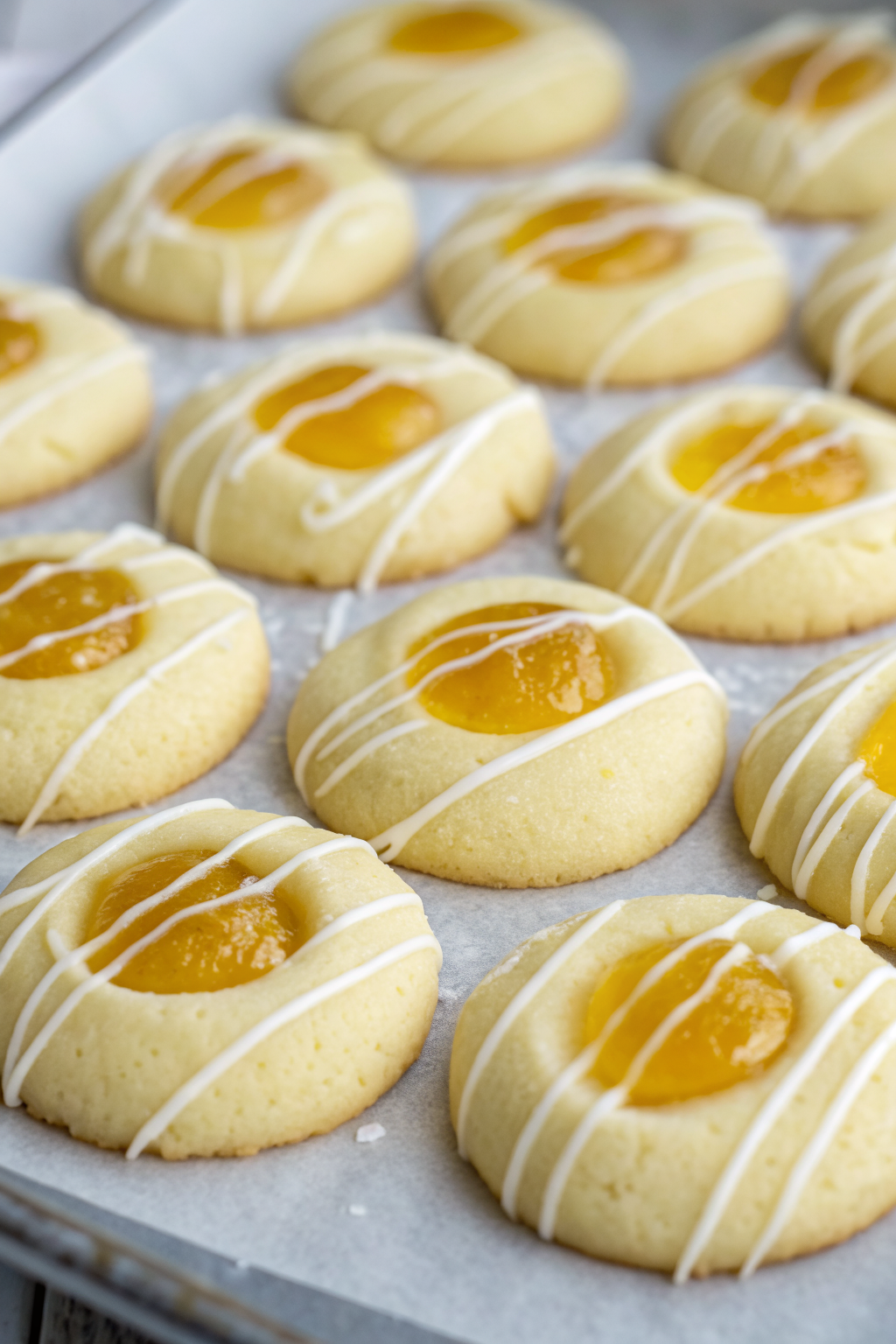
Lemon Thumbprint Cookies Recipe packs tender, buttery shortbread around a tangy lemon curd center with a fresh lemon glaze on top. It suits citrus fans, bake sale heroes, and weeknight sweet tooth moments, and you can finish a batch in about 45 minutes. I baked my first batch after a long road trip and ate two before they cooled.
Why You Should Try This Lemon Thumbprint Cookies Recipe
This Lemon Thumbprint Cookies Recipe gives you bright citrus flavor, melt-in-your-mouth texture, and just the right sweetness. The lemon curd adds sunshine to every bite, and the simple dough stays soft yet sturdy. You can use pantry shortcuts or go all-in with a quick homemade curd.
You can bake these year-round, and the cookies hold up well on cookie trays. The zingy glaze keeps the lemon front and center without overpowering the buttery base.
Crisp edges, soft centers, and bold lemon flavor made these an instant house favorite ★★★★★
Ingredients You’ll Need
- Unsalted butter: 1 cup, softened to cool room temp (226 g). I like Kerrygold for richness, but any quality unsalted butter works.
- Granulated sugar: 2/3 cup (135 g).
- Large egg yolk: 1.
- Vanilla extract: 1 teaspoon.
- Lemon zest: 1 to 1.5 teaspoons, finely grated with a microplane.
- All-purpose flour: 2 cups, spooned and leveled or 240 g. Weigh it for best texture.
- Cornstarch: 2 tablespoons for tender, shortbread-style crumb.
- Fine sea salt: 1/4 teaspoon.
Filling
- Lemon curd: 1/2 to 2/3 cup. Pantry shortcut: use a good jar like Bonne Maman or Trader Joe’s. You can also make the quick version below.
Lemon glaze
- Powdered sugar: 1 cup (120 g), sifted.
- Fresh lemon juice: 2 to 3 tablespoons, to desired thickness.
- Lemon zest: 1/2 teaspoon, optional for extra punch.
- Pinch of salt, to balance sweetness.
Equipment
- Hand mixer or stand mixer with paddle
- Mixing bowls and a rubber spatula
- Microplane zester and citrus juicer
- Sheet pans, parchment paper, and a small cookie scoop
- 1/2 teaspoon measuring spoon or your thumb for the wells
- Wire rack
How to Make Lemon Thumbprint Cookies Recipe
Prep
- Heat the oven to 350°F. Line two sheet pans with parchment.
- Set the lemon curd nearby so you can fill as you shape.
- Measure flour and other dry ingredients before you start to keep things moving.
Make the dough
- Beat butter and granulated sugar on medium speed until creamy and slightly fluffy, about 2 to 3 minutes.
- Add egg yolk, vanilla, and lemon zest. Mix until smooth and fully combined.
- Whisk flour, cornstarch, and salt in a separate bowl. Add to the mixer on low and mix until the dough forms soft clumps and no dry streaks remain.
- If the dough feels sticky, chill it for 10 to 15 minutes to firm slightly.
Shape and fill
- Scoop 1 tablespoon portions. Roll each into a smooth ball and place them 2 inches apart on the pans.
- Press a well into the center of each ball with your thumb or a 1/2 teaspoon measure.
- Spoon about 1/2 teaspoon lemon curd into each well. Do not overfill, since the curd can bubble.
Bake and set
- Bake one pan at a time for 11 to 13 minutes, until edges look set and bottoms show light golden color.
- Let the cookies rest on the pan for 5 minutes. If any wells look shallow, press them gently again with the measuring spoon while warm.
- Move cookies to a wire rack and let them cool completely.
Glaze and finish
- Whisk powdered sugar, lemon juice, zest, and a pinch of salt until smooth and drizzleable. Add a few drops of juice if you want a thinner glaze.
- Drizzle the glaze over the cooled cookies in thin zigzags or spoon tiny halos around the curd.
- Let the glaze set for 15 to 20 minutes before serving.
Quick 5-Minute Lemon Curd (optional)
- Whisk 2 large egg yolks, 1/2 cup sugar, 1/3 cup fresh lemon juice, 1 teaspoon lemon zest, and a pinch of salt in a microwave-safe bowl.
- Microwave in 30-second bursts, whisking after each, until the mixture thickens and reaches 175 to 180°F, about 2 to 3 minutes total.
- Whisk in 4 tablespoons diced unsalted butter until glossy. Press plastic wrap on the surface and chill while you bake.
Tips & Tricks
- Keep butter soft but cool; it should yield to a gentle press, not slump.
- Weigh the flour for best texture, or spoon and level to avoid a dry crumb.
- Use a measuring spoon to make clean, deep wells that hold the curd.
- Stir jarred lemon curd before using to smooth it out.
- Fix surface cracks by nudging them back together with your fingers before baking.
- Don’t overfill the wells; aim for slightly below the rim to prevent bubbling over.
- Rotate the pan at the 8-minute mark if your oven runs hot on one side.
- Glaze after the cookies cool so it sets neatly and stays bright.
- Zest only the yellow peel; the white pith tastes bitter.
- Add 1 tablespoon poppy seeds to the dough for a fun crunch.
What to Serve with Lemon Thumbprint Cookies Recipe
Serve these lemon thumbprint cookies with hot tea, iced tea, or a bright pour-over coffee. Fresh berries and a dollop of whipped cream turn them into an easy dessert plate. For a party platter, pair them with vanilla shortbread and dark chocolate cookies for a sweet-sour-bitter trio. I also pack a couple with Greek yogurt for a sweet lunchbox surprise.
Make-Ahead and Storage
- Store the cookies in an airtight container. Keep them at room temperature up to 24 hours if your kitchen stays cool, or refrigerate up to 5 days.
- Freeze options: Freeze unbaked dough balls up to 2 months, then thaw 30 minutes, indent, fill, and bake. You can also freeze baked, unglazed cookies up to 2 months; thaw, fill with curd, and warm in a 300°F oven for 3 to 4 minutes, then cool and glaze.
- Refresh texture: If the cookies soften in the fridge, warm them on a sheet pan at 300°F for 3 to 4 minutes, cool, then drizzle fresh glaze if needed.
Lemon Thumbprint Cookies Recipe
Ingredients
Instructions
- Heat the oven to 350°F (175°C). Line two sheet pans with parchment paper.
- Set the lemon curd nearby so you can fill the cookies as you shape them.
- Measure the flour and other dry ingredients before you start mixing the dough.
- Beat the butter and granulated sugar on medium speed until creamy and slightly fluffy, about 2 to 3 minutes.
- Add the egg yolk, vanilla extract, and lemon zest. Mix until smooth and fully combined.
- In a separate bowl, whisk together the flour, cornstarch, and salt. Add the dry mixture to the butter mixture on low speed and mix until the dough forms soft clumps and no dry streaks remain.
- If the dough feels sticky, chill it in the refrigerator for 10 to 15 minutes to firm slightly.
- Scoop about 1 tablespoon portions of dough. Roll each portion into a smooth ball and place them 2 inches apart on the prepared pans.
- Press a well into the center of each dough ball with your thumb or a 1/2 teaspoon measuring spoon.
- Spoon about 1/2 teaspoon lemon curd into each well, taking care not to overfill so the curd does not bubble over while baking.
- Bake one pan at a time for 11 to 13 minutes, until the edges look set and the bottoms are a light golden color.
- Let the cookies rest on the pan for 5 minutes. If any wells look shallow, gently press them deeper again with the measuring spoon while the cookies are still warm.
- Transfer the cookies to a wire rack and let them cool completely.
- In a small bowl, whisk together the powdered sugar, lemon juice, lemon zest (if using), and a pinch of salt until smooth and drizzleable. Add a few extra drops of lemon juice if you want a thinner glaze.
- Drizzle the glaze over the cooled cookies in thin zigzags or spoon small halos around the lemon curd centers.
- Let the glaze set for 15 to 20 minutes before serving or storing.
- In a microwave-safe bowl, whisk together the egg yolks, sugar, lemon juice, lemon zest, and a pinch of salt.
- Microwave in 30-second bursts, whisking after each, until the mixture thickens and reaches 175–180°F, about 2 to 3 minutes total.
- Whisk in the diced butter until the curd is smooth and glossy. Press plastic wrap directly onto the surface and chill while you bake the cookies.
Notes
Approximate per 1 cookie (about 30 cookies total): 120 calories; fat 7 g; saturated fat 4 g; carbohydrates 14 g; fiber 0 g; sugars 7 g; protein 1 g; sodium 40 mg. Values will vary based on exact curd, glaze thickness, and portion size.